How to Choose Pharmaceutical Equipment for R&D and Pilot Production
Equipment chosen at R&D and pilot stages shapes how much a team can learn about a formulation and how smoothly the process later transfers to larger equipment. The two stages have different goals, and equipment that suits one is not always right for the other.
The Purpose of Each Stage
R&D work is about learning. Teams screen formulations, test excipient combinations and establish whether a product can be made at all. Batches are small, materials are often expensive or scarce, and the formulation may change several times.
Pilot work is about confirming. The formulation is largely settled, and the aim is to show that the process can be run repeatedly with consistent results, at a scale large enough to reveal how materials and equipment behave beyond the bench.
Because the goals differ, the equipment priorities differ too. R&D favours flexibility and low material use. Pilot favours repeatability and a close resemblance to the eventual production process.
Batch-Size Considerations
Batch size is usually the first constraint. R&D equipment must work with small quantities without excessive loss, which matters when an active ingredient is costly. Pilot equipment needs enough capacity to produce meaningful batches for process studies, stability samples or early supply.
It is worth estimating batch sizes for both the current stage and the next one. Equipment that handles a wide range of batch sizes can bridge stages, but it may compromise on performance at either end of that range. Our Scale-Up Solutions page shows illustrative ranges for each stage.
Formulation Requirements
The formulation determines which equipment families are relevant. For a tablet, powder flow and compressibility affect press choice and tooling. For a cream, viscosity and heating requirements affect the mixer. For a capsule, fill-weight consistency depends on how the powder behaves in the dosing mechanism.
Properties worth characterising early
- Powder flow and bulk density
- Compressibility and hardness response
- Particle size distribution
- Viscosity and shear sensitivity for semisolids and liquids
- Moisture and heat sensitivity
Knowing these properties before selecting equipment reduces the risk of buying a machine that cannot process the material well.
Equipment Flexibility
At R&D stage, flexibility is valuable. Benchtop equipment with quick changeover lets a team run many small experiments in a short time. Interchangeable tooling, adjustable parameters and easy cleaning all help.
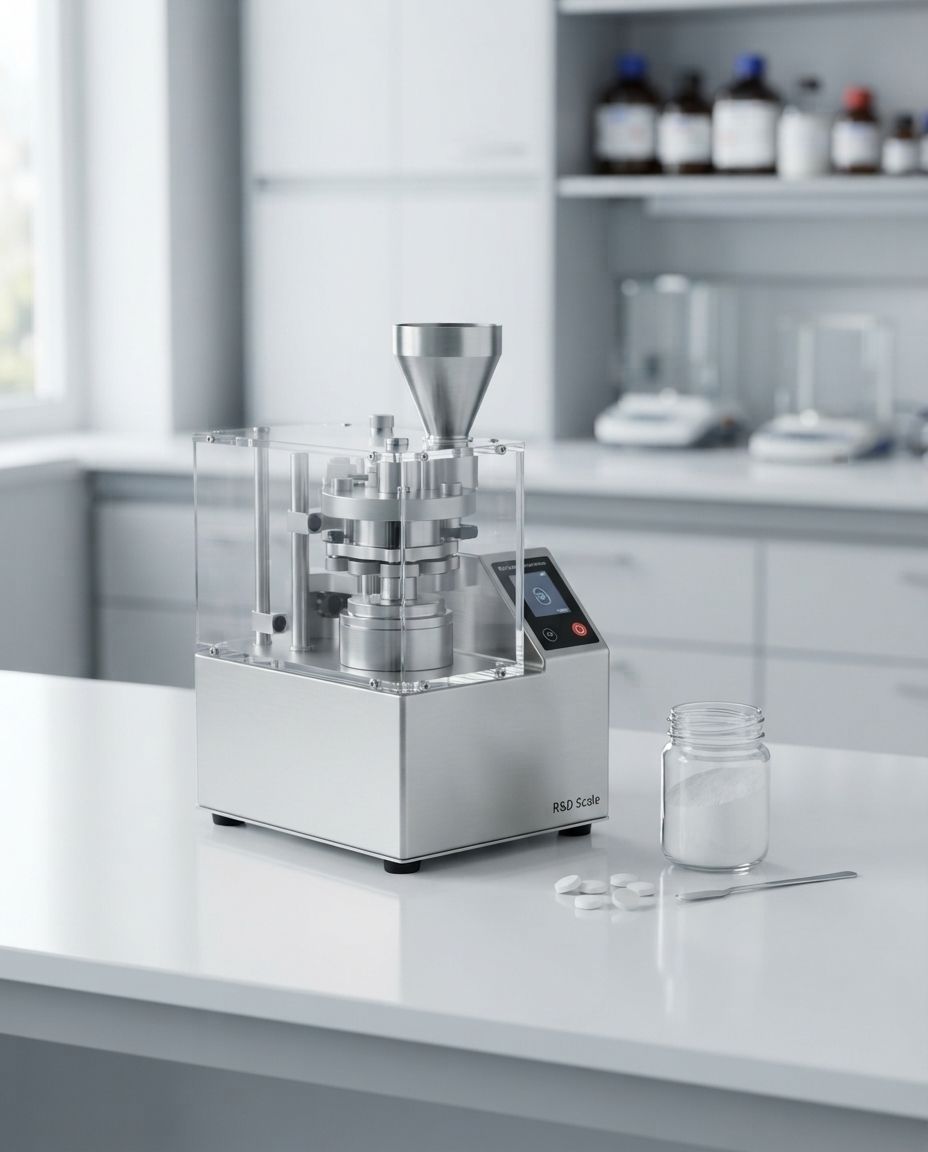
At pilot stage, the balance shifts. Some flexibility remains useful, but equipment that shares its operating principle with production equipment makes the eventual transfer more predictable. A single-punch press is well suited to formulation work; a small rotary press is often a better guide to how a blend will behave at production speed.
Process Repeatability
Pilot work exists to demonstrate that the process gives the same result each time. Equipment should allow parameters to be set, recorded and reproduced. Controls that display and log key settings, and designs that reduce operator-dependent variation, support this.
Repeatability also depends on the steps before and after the main machine. A consistent blend, a stable environment and reliable in-process testing matter as much as the press or mixer itself.
Planning for Scale-Up
Equipment choices at R&D and pilot stage influence how easily a process scales. Where possible, choose equipment whose operating principle matches what is likely to be used at production scale, and record process parameters in terms that can be translated, such as compression force rather than a dial position.
Consider facility constraints early as well. Space, utilities and room classification can limit what can be installed later, and they are easier to plan for before pilot work is complete. The Equipment overview groups the main equipment categories by process.
Cleaning and Changeover
R&D teams often switch between formulations several times a week, so cleaning time can limit how many experiments are possible. Equipment with few product-contact parts, tool-free disassembly and smooth surfaces shortens turnaround between trials.
At pilot scale, cleaning becomes part of the process being evaluated. How long it takes, how it is verified and how it would work in a production setting are worth recording alongside the process data. Equipment that is difficult to clean at pilot scale is rarely easier at production scale.
Questions to Ask Before Selecting Equipment
- What is the dosage form, and what are the key properties of the formulation?
- What batch sizes are needed now, and what will the next stage require?
- Which process parameters must be controlled and recorded?
- How similar is this equipment to what would be used at production scale?
- How long do cleaning and changeover take?
- What space, utilities and environmental controls does it need?
- Which in-process tests will run alongside it?
Conclusion
R&D and pilot equipment serve different purposes. R&D equipment should help a team learn quickly with small quantities; pilot equipment should show that the process is repeatable and give a reliable guide to production. Working through the questions above before purchasing helps match equipment to the stage and reduces surprises during scale-up.
This article provides general information for planning purposes. It is not regulatory or validation guidance; requirements depend on the specific product, process and jurisdiction.