From Formulation to Production: Understanding Pharmaceutical Scale-Up
Scale-up is often described as making more of a product. In practice it is a series of decisions about the formulation, the process, the equipment and the facility, each of which affects the next.
Formulation Development
Every scale-up starts with a formulation. During development, teams choose the form of the active ingredient, select excipients and establish a composition that delivers the intended dose and performance. Material properties identified here, such as flow, particle size and moisture sensitivity, carry through every later stage.
Decisions made for convenience at the bench can create difficulties later. A blend that works when mixed by hand may segregate in a larger blender. A cream that is easy to make in a beaker may trap air in a larger vessel. Considering processability during formulation work reduces later rework; see Formulation Development.
Process Development
Process development turns a formulation into a defined sequence of steps. For a tablet this might be weighing, sifting, blending, compression and testing. For a cream it might be phase preparation, heating, emulsification, homogenization, cooling and filling.
At this stage the team identifies which parameters matter: blending time, compression force, mixing speed, temperature profile. These parameters become the basis for transferring the process to larger equipment.
R&D Production
R&D-scale production makes small batches using compact equipment. The aim is to confirm that the process works and to generate material for early testing. Equipment is chosen for flexibility and low material use.
Good records at this stage pay off later. Recording process settings, environmental conditions and in-process results makes it possible to compare R&D batches with pilot batches.
Pilot-Scale Evaluation
Pilot-scale work tests the process at an intermediate size. It reveals effects that small batches can hide, such as heat build-up during mixing, changes in powder flow through larger hoppers, or variation in fill weight at higher speeds.
What pilot work typically examines
- Whether key parameters still give consistent results
- How materials behave in larger equipment
- Batch-to-batch repeatability
- Practicality of cleaning and changeover
- Yield and material losses
Problems found at pilot scale are generally less costly to address than problems found in production.
Production-Scale Planning
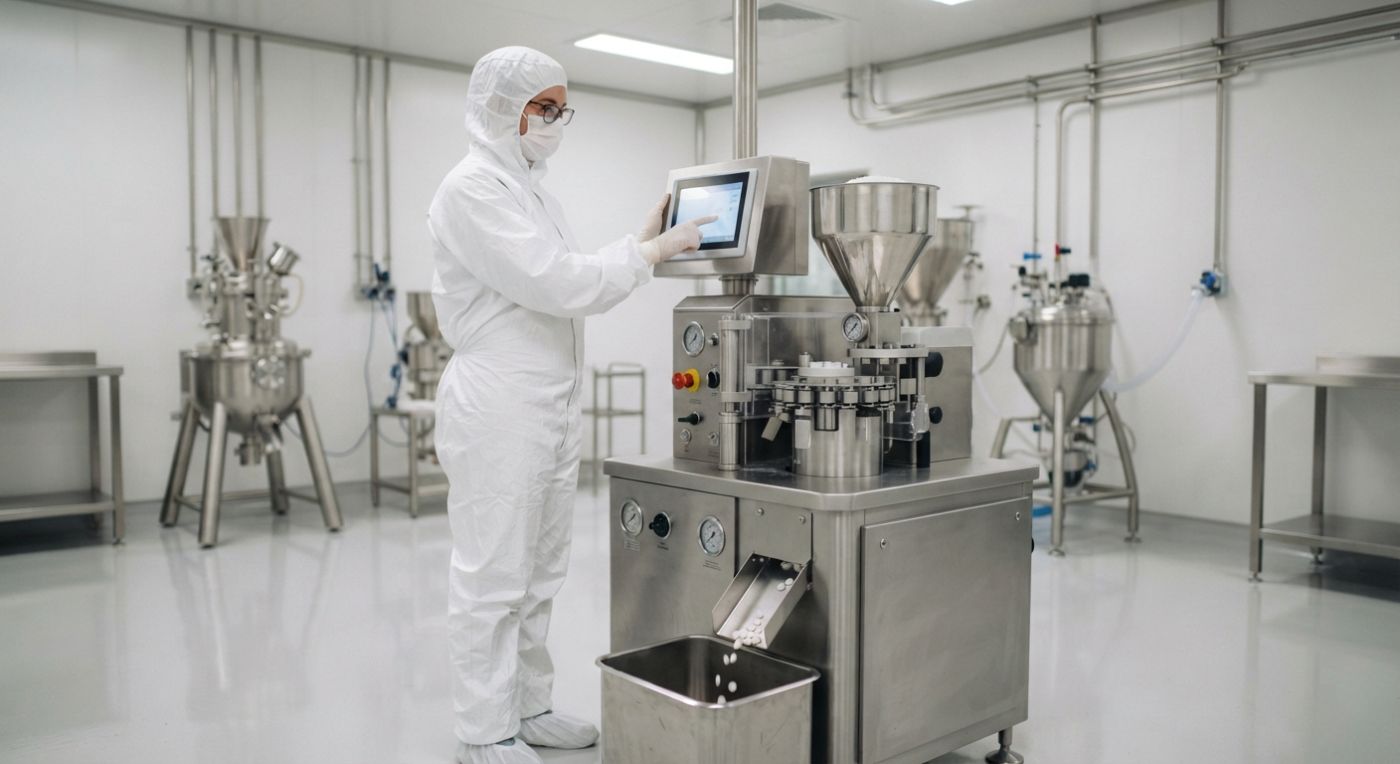
Production planning looks at the equipment, workflow and facility needed for ongoing manufacture. Throughput targets, shift patterns, product variety and changeover frequency all influence equipment selection.
This is also the point where individual machines become a line. Material movement between steps, packaging integration and in-process testing need to be planned together rather than piece by piece. The Scale-Up Solutions page summarises the three stages.
Equipment Compatibility
A process transfers most smoothly when equipment at each stage shares an operating principle. Moving to a completely different blender design, or from manual filling to an automatic filler with a different dosing mechanism, can change results even when the formulation is unchanged.
Where a change of equipment type cannot be avoided, plan additional evaluation to confirm the process still performs as intended.
Documentation Through the Stages
Each stage produces information the next stage depends on: formulation rationale, process parameters, equipment settings, in-process results and observations about how materials behaved. Keeping this record consistent across stages makes it easier to see what changed when results differ.
Recording settings in physical terms, such as force, speed, temperature and time, rather than machine-specific positions also helps when the process moves to different equipment.
Manufacturing Workflow Considerations
- Material flow from receipt and weighing through to packaging
- Separation of process steps and products
- Personnel movement and gowning
- Cleaning access and drainage
- Utilities such as power, water, compressed air and extraction
- Space for in-process testing and storage
Conclusion
Scale-up is a sequence of connected decisions. A formulation designed with processing in mind, a process with clearly defined parameters, and equipment chosen for compatibility across stages make the path to production more predictable. Reviewing facility and workflow needs early helps avoid constraints later.
This article provides general information for planning purposes. It is not regulatory or validation guidance; requirements depend on the specific product, process and jurisdiction.